
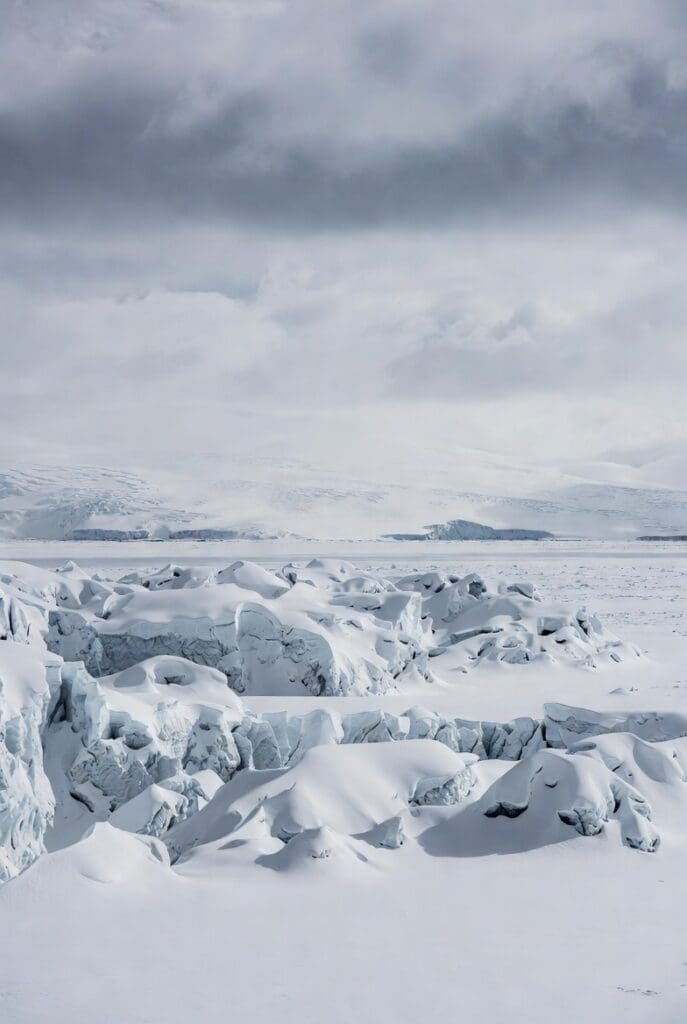
THE ANTARCTICA ESSAYS: ARCHITECTURE, ART, AND HUMAN SYSTEMICS UNDER ABSOLUTE CONSTRAINT
Antarctica is not central to daily conversation. It is central to the future.
As the least inhabited continent on Earth, Antarctica remains one of the few places where human presence is still provisional—temporary, regulated, and deliberate. There are no cities, no private land ownership, no permanent civilian homes. Every structure exists by necessity, design, and international agreement.
That makes Antarctica uniquely instructive. Here, architecture is not expression first; it is survival. Here, art is not commerce; it is interpretation. Here, home is not possession; it is stewardship.
+-------------------------------------------------------------------------+
|                      THE SOVEREIGN POLAR PARADIGM                       |
+---------------------+-----------------------------+---------------------+
|  CONCEPT            | STANDARD CONSUMER LENS      | ANTARCTIC LENS      |
+---------------------+-----------------------------+---------------------+
|  ARCHITECTURE       | Speculative Sprawl / Profit | Absolute Survival   |
+---------------------+-----------------------------+---------------------+
|  ART                | Commercial Market Commodity | Direct Testimony    |
+---------------------+-----------------------------+---------------------+
|  HOME               | Real Estate Possession      | Shared Stewardship  |
+---------------------+-----------------------------+---------------------+
At Home & Art Magazine, Antarctica is not covered for novelty or spectacle. It is covered because it represents the outer edge of the questions we ask everywhere else: What does it mean to build without ownership? How do we design when permanence is not guaranteed? What happens when climate, logistics, and ethics outweigh profit? How does culture persist in extreme, temporary conditions?
Antarctica forces clarity. There is no excess space, no margin for waste, no decorative indulgence without consequence. Every structure is intentional. Every object is accounted for. Every human presence leaves a trace. This is not about heroism. It is about discipline.
1. Architectural Geography: The Five Polar Zones of Survival
To understand human habitation at the limits of viability, the continent must be analyzed through its five distinct structural and climatic zones. Each region enforces its own material constraints, spatial typologies, and adaptive systems.
I. East Antarctica (Greater Antarctica) — The High-Altitude Citadel
East Antarctica features the coldest, highest, and most sensorially monotonous environment on Earth. It is a massive, high-altitude polar desert resting on a solid continental landmass.
-
The Enclosed Life-Support Envelope: Modern stations, such as the Franco-Italian Concordia or the futuristic, zero-emission Belgian Princess Elisabeth Antarctica, function as hyper-insulated, sealed citadels. To counteract the absolute blackness of the polar night and the blinding white of the polar day, interiors utilize deliberate color psychology. Monotonous industrial surfaces are replaced with warm, tactile materials like natural wood veneer paneling and vibrant, saturated primary colors (oranges, warm greens, and deep blues) to stimulate the human nervous system and mitigate psychological cabin fever.
-
The Acoustics of Isolation: In a place where sub-zero katabatic winds hammer the structural shell continuously, the interior layout relies on rigorous acoustic zoning. Living quarters are highly segmented, isolating loud communal generator hubs and laboratories from sleeping quarters to ensure deep sleep and mental recovery.
II. West Antarctica (Lesser Antarctica) — The Industrial Outpost
West Antarctica sits mostly in the Western Hemisphere and features a highly dynamic, marine-based ice sheet plagued by high stakes glaciological volatility.
-
The Sprawl of McMurdo Station: The premier habitation hub in this region is the United States’ McMurdo Station, which functions less like an architectural monument and more like a rugged, blue-collar frontier town. The interior aesthetic here is deeply rooted in mid-to-late 20th-century industrial utility—featuring prefabricated panelized wood structures, retrofitted Quonset huts, and heavy-duty industrial carpeting designed to withstand the tracking of volcanic grit and mud.
-
The Transient Dormitory: Unlike the small, family-like crews of East Antarctica, West Antarctic spaces accommodate hundreds of transient workers. Private rooms are highly compact, resembling ship cabins, making personalized micro-decorating (taping up personal photos, tapestries, and mapped landscapes) an essential ritual for establishing identity within a fluid, temporary community.
III. The Antarctic Peninsula — The Biophilic Sanctuary
Extending toward South America, the Antarctic Peninsula is the most visited region of the continent, famous for its dramatic mountain peaks, calving glaciers, and abundant wildlife colonies. It possesses the mildest coastal climates.
-
Aerodynamic and Elevated Shells: Modern stations along the Peninsula—such as Britain’s Halley VI or Brazil’s Comandante Ferraz—resemble sleek, space-age vessels. They are raised on hydraulic stilts to prevent being buried by heavy coastal snow accumulation, allowing the fierce drifting winds to pass cleanly underneath the structure.
-
The Horizon Window: Because the Peninsula boasts breathtaking visual landscapes, common rooms are built around massive, triple-paned panoramic windows. These glass walls serve a dual purpose: they flood the interior with natural light to regulate human circadian rhythms and structurally frame the landscape, turning the wild Antarctic environment into the primary living art piece of the collective interior.
IV. The Transantarctic Mountains — The Temporal Field Camp
This titanic, -long mountain range structurally divides the continent and exposes ancient geological rock strata. It features no permanent urbanization.
-
The Deep-Field Jamesway Tent: For mobile field scientists, home is a Jamesway tent—a portable, insulated, fabric-covered arch structure with a raised wooden floor platform that has remained largely unchanged since the mid-20th century. The interior is minimalist and cozy, heated by a single oil stove, smelling of canvas, wool socks, and freeze-dried rations.
-
The Heroic Age Huts: Nestled at the foothills of the range on Ross Island are the historic wooden huts of Scott and Shackleton. These structures represent the birth of the Antarctic home: dark, heavy timber frames insulated with felt, cork, or seaweed, where early explorers lived in close quarters amidst crates of provisions, sealing blubber lamps, and scientific specimen jars.
V. The Sub-Antarctic Islands — The Maritime Homestead
Positioned north of the permanent ice sheets but locked within the tempestuous Antarctic Convergence, islands like South Georgia or the Falklands feature a unique sub-polar maritime climate.
-
The Corrugated Zinc Settlement: The architectural heritage of these islands is deeply tied to British and Scandinavian maritime design. Structures feature steeply pitched, gabled corrugated iron roofs painted in bright, vibrant reds and greens to contrast sharply against the foggy, overcast grey skies.
-
The Mudroom-Centric Layout: Because these islands are carpeted in wet tussock grass, peat bog, and mud, the domestic layout of a sub-antarctic home revolves entirely around the mudroom (the boot room). This space is heavily engineered with industrial drainage floors, boot washers, and massive drying racks for wet foul-weather gear.
2. Core Editorial Scope: Designing at the Limits
Our ongoing coverage focuses rigorously on how humans design, inhabit, and interpret space under conditions that foreshadow the future elsewhere: climate volatility, finite resources, extreme regulation, and high ethical scrutiny.
Architecture Under Absolute Constraint
We report systematically on the mechanical and physical realities of polar development:
-
Research Stations as Architectural Systems: Evaluating stations not as collection of buildings, but as integrated machines that generate power, purify water, and process life-support mechanics.
-
Prefabrication and Modular Infrastructure: Exploring how buildings must be completely pre-assembled and tested off-site before being shipped across the world’s most treacherous oceans for rapid assembly during the brief polar summer.
-
Closed-Loop Living Systems: Documenting advanced energy efficiency, wastewater recycling, and zero-emission operations that minimize the human footprint on untouched terrain.
+-------------------------------------------------------------------------+
|                        THE VOLUMETRIC SPACE RATIO                       |
+-------------------------------------------------------------------------+
| [██████████████████████████████████████████] FUNCTIONAL MASS (60%)       |
| Laboratories, Life Support Systems, Mechanical Hubs, Storage            |
+------------------------------------------------------------+------------+
| [██████████████████████████████] BIOPHILIC RESTORATION (30%)|            |
| Communal Mess Halls, High-Light Atriums, Circulation Zones |            |
+-----------------------------------------------+------------+------------+
| [███████████] PRIVATE SANCTUARY (10%)          |                         |
| Compact Sleeping Quarters, Acoustic Isolation Pods                      |
+-----------------------------------------------+-------------------------+
Home at the Edge of Permanence
There are no traditional homes in Antarctica, but there are lived spaces. Sleeping quarters, laboratories, communal kitchens, corridors, observation rooms—these are environments where people work, rest, argue, create, and endure isolation for months at a time. We examine how domesticity is recreated without consumer comfort, how privacy is negotiated in shared systems, and how routine and ritual sustain mental health when nature is completely hostile. Antarctica reveals what is essential to the idea of home—by stripping everything else away.
3. Art Where Nothing is for Sale
Antarctica has no galleries, markets, or collectors. Yet art exists there. Artists, writers, photographers, and composers have long been drawn to the frozen continent not to sell work, but to witness, interpret, and translate an environment most people will never experience directly. In Antarctica, art functions less as object and more as testimony.
The Manifestation of Polar Artistry
-
Community Murals as Visual Escapism: To combat the psychological phenomenon known as the “Halley Stare”—a state of catatonic daydreaming caused by profound sensory deprivation—wintering crews have established a tradition of painting vibrant, large-scale landscapes of forests, green fields, and warm oceans directly onto the interior corridors of buried stations.
-
The Camera Artist Legacy: Modern field photography traces its roots back to Herbert Ponting and Frank Hurley, the official photographers of the Heroic Age. Their historical images, capturing the stark, graphic geometry of ice cliffs and the structural failure of wooden ships crushed by pack ice, are preserved as prominent art walls within modern stations, connecting past and present residency.
-
Industrial Post-Modernism: In larger logistics hubs like McMurdo, a unique “waste stream” craft tradition has evolved. Workers weld together decommissioned heavy machinery scraps, broken scientific instruments, and industrial waste to create expressive, heavy-metal outdoor sculptures that punctuate the volcanic terrain.
-
Acoustic and Sound Art: Contemporary multimedia artists use specialized hydrophones suspended beneath sea ice to capture the deep, structural groans of shifting ice shelves and the haunting underwater calls of migrating marine mammals, transforming scientific data into immersive auditory art installations.
4. A Mirror for the Rest of the World
What happens in Antarctica does not stay in Antarctica. Design principles tested there—energy efficiency, closed-loop waste management, lightweight materials, and adaptive, climate-resilient structures—are increasingly relevant to cities facing global heat, flooding, isolation, and scarcity.
Antarctica shows what building looks like when climate is non-negotiable, resources are finite, cooperation is mandatory, and extraction is prohibited. It is the absolute opposite of sprawl. It is a preview of constraint.
Editorial Tone & Restraint
Our coverage of Antarctica is written with absolute restraint and precision. We avoid sensationalism, political theater, and empty awe. We prioritize explanation, documentation, and consequence. This is not coverage meant to excite; it is coverage meant to endure.
Antarctica is not the past. It is not untouched wilderness. It is not science fiction. It is a living reference point—for how we may be forced to live elsewhere sooner than we expect.
