
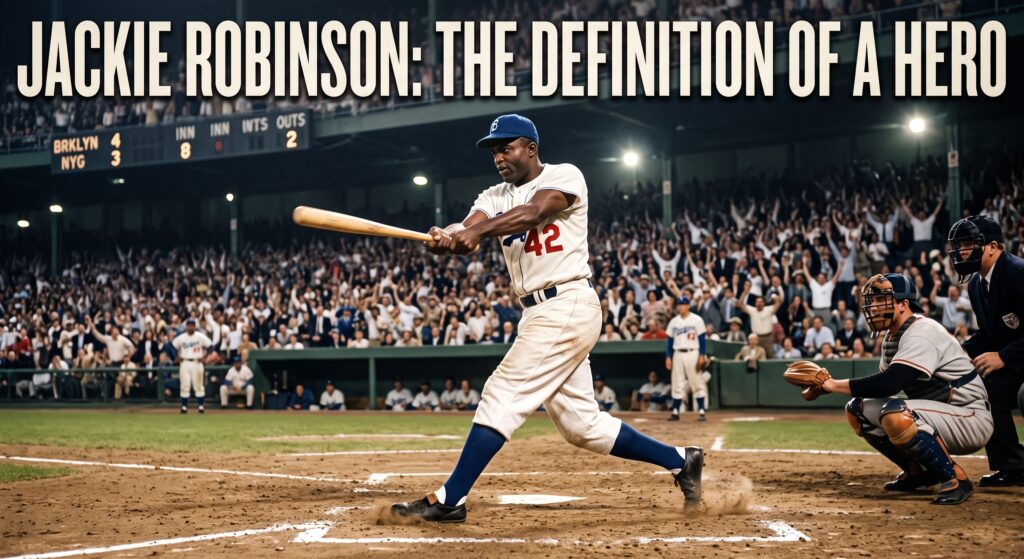
The phrase “American Hero” is often worn down by overuse—tossed casually at stat leaders, clutch shooters, or charismatic figures on a highlight reel. Jackie Robinson dismantles that shallow definition entirely. The making of Jackie Robinson as a genuine American hero was not that he could hit a fastball or outrun a throw from deep center field. It was that he turned his own body, his craft, and his home life into a living frontline for the soul of the country.
1. The Crucible: Heroism as Weaponized Restraint
In the American mythology of the hero, the standard archetype is aggressive—the conqueror who takes ground by force. Robinson subverted the mold entirely: he conquered by enduring.
When Branch Rickey brought Robinson into the Brooklyn Dodgers organization in 1945, the mandate was psychologically brutal: absorb racial venom, beanballs hurled at your skull, spiked cleats, and death threats without firing back a single punch.
For a fiercely proud four-sport athlete and former U.S. Army lieutenant—who had already court-martialed and won his case against segregated military busing—restraint wasn’t weakness; it was strategic discipline. On the basepaths, he took that suppressed fury and turned it into kinetic art. He danced off third base, disrupted pitchers’ timing, and stole home with theatrical audacity, forcing white America to confront his excellence in real time.
2. The Domestic Battle: Redefining Belonging
A hero is only as enduring as the ground they stand on. For Robinson, the fight never ended at the dugout steps. When he and Rachel Robinson took on the covert, polite racism of Northern redlining in the 1950s to build 103 Cascade Road in Stamford, Connecticut, they proved that the battle for dignity was as much about the family living room as the public stadium.
Their mid-century modernist sanctuary didn’t just shield them from the storm; it became a staging ground. When Dr. Martin Luther King Jr. and the foot soldiers of the Civil Rights Movement needed cash to bail student demonstrators out of Birmingham jails in 1963, the Robinsons threw open their gates for “An Afternoon of Jazz.” Real heroes don’t pull up the ladder behind them; they turn their lawn into an amphitheater of resistance.
3. Economic Autonomy: The Unvarnished Activist
Hollywood often freezes Jackie Robinson in 1947, preserving him in amber as a smiling rookie in white flannel. But the true measure of his heroism deepened after he hung up his cleats:
-
In the Boardroom: He stepped into corporate America as an executive at Chock full o’Nuts to demand equal employment.
-
In the Financial Sector: He co-founded Harlem’s Freedom National Bank in 1964 because he knew political freedom was a mirage without access to capital, home mortgages, and small-business credit for Black Americans.
-
In Politics: He refused to be an instrument for any single political machine, firing off blistering telegrams to Presidents Eisenhower, Kennedy, and Nixon whenever federal action stalled.
4. The True Metric of a Hero
Robinson famously inscribed his own philosophy into American history:
“A life is not important except in the impact it has on other lives.”
Jackie Robinson didn’t just break a color barrier in professional sports; he forced the nation to look in the mirror, expose its contradictions, and expand its definition of democracy. Backed by the formidable strength and vision of his wife, Rachel, he showed that the real making of an American hero is not about escaping the fire—it’s about walking straight through it so others can follow.
The Sanctuary and the Storm: How Jackie and Rachel Robinson Bankrolled the Revolution
1. The Anatomy of Restraint
On April 15, 1947, Ebbets Field was a crucible of iron trusses, green timber grandstands, and raw postwar tension. When Jack Roosevelt Robinson emerged from the dugout wearing No. 42, the chalk baseline he crossed was more than a boundary line on a baseball diamond—it was the fault line of the American social contract.
When Dodgers president Branch Rickey signed Robinson out of the Negro Leagues’ Kansas City Monarchs, he did not just evaluate swing mechanics or defensive range. He calculated the precise psychological toll of bearing a nation’s racial pathology. In their famous closed-door meeting in 1945, Rickey tested Robinson with simulated racial slurs and hostile provocations. Robinson famously asked:
“Mr. Rickey, do you want a Negro who’s afraid to fight back?”
“I want a ballplayer with guts enough not to fight back,” Rickey replied.
Robinson weaponized composure. His style of play was kinetic jazz: daring leads off first base, sudden shifts in center of gravity that forced balks, and his signature masterpiece—the slide into home plate, disrupting the defensive geometry of the diamond. Behind the stoic exterior, however, the toll was heavy. Robinson suffered insomnia, digestive disorders, and an endless barrage of hate mail and death threats delivered straight to team clubhouses.
Watch: Experience the tension, the athletic fury, and the cultural magnitude of Robinson’s Brooklyn years in the official preview for Ken Burns’ Jackie Robinson (PBS), which documents the emotional and physical gauntlet of breaking the color line.
The diamond was a relentless proving ground. Robinson needed a counterweight—a private sanctuary where he could cease being a national lightning rod and simply be a husband, father, and man.
2. Redlining the American Dream: The Battle for Stamford
By the early 1950s, Jackie Robinson was a household hero, a National League MVP, and the beating heart of Brooklyn’s “Boys of Summer.” Yet when Jackie and his wife, Rachel Robinson, sought to purchase a home in the leafy suburbs of Westchester County, New York, and Fairfield County, Connecticut, they collided with the rigid, polite machinery of Northern housing segregation.
Brokers told them homes were under deposit; sellers pulled listings off the market the moment the Robinsons arrived; neighborhood associations organized quiet resistance. The message was clear: Robinson could thrill suburban crowds at Ebbets Field, but he was unwelcome on their tree-lined streets.
The barrier broke when the Bridgeport Herald published an exposé on the discriminatory roadblocks facing the Dodgers star. Reading the piece in Riverdale, Andrea Simon—wife of Simon & Schuster co-founder Richard Simon—was outraged. She contacted Rachel Robinson, arranging an immediate rendezvous off the Merritt Parkway.
The Simons invited the Robinsons into their Connecticut circle, introduced them to progressive civic leaders and local bankers, and opened their estate to the family for over a year while a new house took shape.
Watch: Hear singer Carly Simon recount that fateful summer of 1954 when the Robinsons lived at the Simon family estate in Carly Simon on the Robinson Family Connection, sharing rare personal memories of Jackie’s warmth and quiet dignity.
In 1954, the Robinsons secured their ground: a secluded six-acre wooded parcel complete with its own pond at 103 Cascade Road in North Stamford.
3. 103 Cascade Road: Mid-Century Modernism as Sanctuary
Rachel Robinson, who had earned her master’s degree in psychiatric nursing and possessed a sharp eye for spatial design, worked alongside builder Ben Gunnar to design a home that rejected traditional suburban compartmentalization.
The residence was designed as a living expression of organic modernism:
-
Topographical Integration: Constructed of warm cedar and native fieldstone, the low-slung house was embedded into the rocky New England contours and surrounded by a dense canopy of hemlocks, oaks, and maples.
-
Erasing Boundaries: Massive floor-to-ceiling glass walls looked outward toward the forest and the pond, filling the interior with shifting natural light across the seasons.
-
The Living Hearth: An expansive stone fireplace anchored the great room, establishing a communal sanctuary where the family—Jackie Jr., Sharon, and David—could retreat from the public eye.
-
Art and Domestic Grace: Rachel curated the interiors with modernist furniture, books, and contemporary Black art, creating an atmosphere of intellectual rigor, dignity, and warmth.
For Jackie, 103 Cascade Road was an oasis. He built a small putting green on the lawn, rowed on the pond with his children, and spent hours listening to records by the fireplace. For the first time since signing with Brooklyn, he had a fortified harbor of peace.
Watch: Explore the intellectual and emotional partnership between Rachel and Jackie—and the domestic sanctuary they built together—in PBS’s Feature on Rachel & Jackie Robinson’s Partnership.
4. “An Afternoon of Jazz”: Mobilizing the Lawn
In May 1963, Birmingham, Alabama, erupted into a moral crisis. The Southern Christian Leadership Conference’s (SCLC) Children’s Crusade was met with high-pressure fire hoses and attack dogs. When thousands of young students were arrested, Dr. Martin Luther King Jr.’s movement was threatened with operational paralysis—the organization was running out of bail money.
Watch: See raw, on-the-ground footage of Jackie speaking out against the Birmingham police crackdown in Jackie Robinson Addresses Civil Rights Mass Meeting in Alabama (Reuters Archive), recorded just weeks before the Robinsons opened their lawn to the public.
Looking out across the rolling lawn descending toward their pond, Rachel realized their private retreat could become a functional engine for the movement.
On June 23, 1963, the Robinsons hosted the inaugural “An Afternoon of Jazz.”
-
The Stage: Rachel had a simple wooden bandstand erected near the water’s edge, surrounded by folding chairs and open lawn for picnic blankets.
-
The Lineup: The greatest jazz luminaries of the era—including Duke Ellington, Dizzy Gillespie, Thelonious Monk, Dave Brubeck, Billy Taylor, and Sarah Vaughan—agreed to play pro bono, waiving performance fees and paying their own travel costs.
-
The Guest of Honor: Dr. King traveled to Stamford, walking among the crowd of 2,500 people, shaking hands, sharing lunch, and addressing the gathering from the grass.
“Jackie Robinson incessantly raises questions to sear America’s conscience. He was a sit-inner before sit-ins, a freedom rider before freedom rides.”
— Dr. Martin Luther King Jr.
The afternoon collected more than $15,000 in direct gate cash (equivalent to roughly $150,000 today). The funds were wired south to post bail for jailed student demonstrators, keeping the movement alive through a critical summer.
The concerts became an annual Stamford tradition, continuing through the 1960s as a unique crossroads where modern jazz, civil rights leaders, and integrated crowds converged.
5. Beyond the Diamond: Power, Business, and Direct Action
Robinson’s activism extended far beyond symbolic appearances. Following his retirement from baseball in 1956, he entered the corporate and political spheres with the same fierce independence he brought to the basepaths:
-
Executive Leadership: He became vice president of personnel at Chock full o’Nuts, making him one of the first Black corporate executives at a major American company.
-
Economic Empowerment: Recognizing that true integration required financial autonomy, Robinson co-founded Freedom National Bank in Harlem in 1964, providing credit, mortgages, and commercial loans to Black entrepreneurs and homebuyers shut out of conventional banking.
-
Affordable Housing: He formed the Jackie Robinson Construction Corporation, developing quality, affordable housing projects for working-class families in urban centers.
-
Political Independence: Robinson wielded his pen as a weapon, firing off blistering telegrams to Presidents Dwight D. Eisenhower, John F. Kennedy, Lyndon B. Johnson, and Richard Nixon, refusing to serve as a rubber stamp for either political party.
Watch: Hear Jackie articulate his uncompromising views on political independence and racial justice in this archival clip: July 10, 1964 | Jackie Robinson Television Interview.
To President Eisenhower in 1957, regarding federal foot-dragging in the South, Robinson wrote:
“17 million Negroes cannot do as you suggest and wait for the hearts of men to change. We want to enjoy now the rights that we feel we are entitled to as Americans.”
6. The Enduring Architect: Rachel Robinson
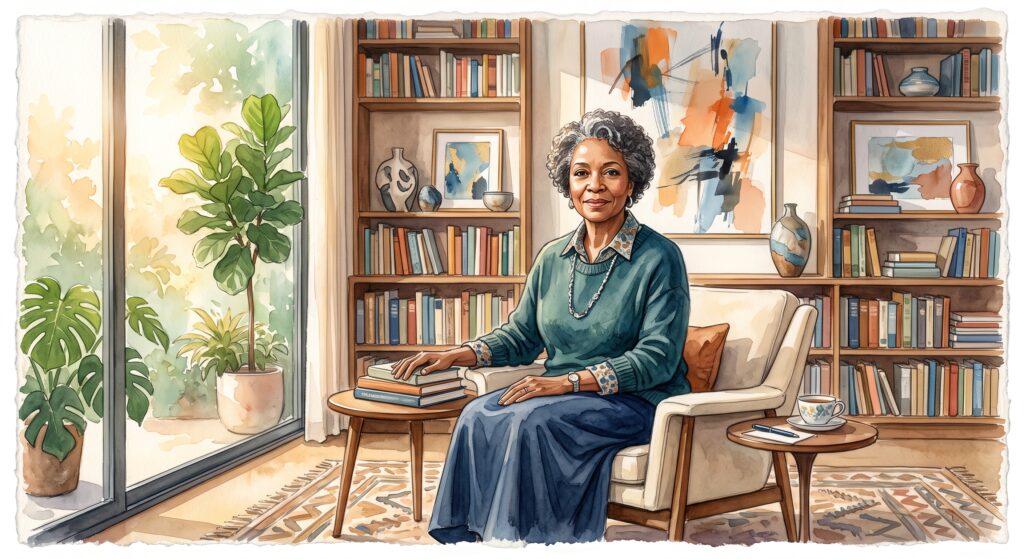 Jackie Robinson passed away from complications of diabetes and heart disease on October 24, 1972, at his home on Cascade Road. He was just 53 years old. In the wake of his death, Rachel Robinson ensured his life’s work remained an active, institutional force.
A scholar and former assistant professor of psychiatric nursing at Yale University, Rachel founded the Jackie Robinson Foundation (JRF) in 1973. She redirected the annual “Afternoon of Jazz” concerts to fund four-year college scholarships, leadership conferences, and career development programs for minority youth. Born on July 19, 1922, Rachel Robinson celebrated her 104th birthday in July 2026. She continues to stand as an extraordinary living bridge to the Civil Rights Movement, the golden era of baseball, and the enduring architectural and educational legacy she built from the ground up.
Today, the Foundation boasts:
-
A 98% college graduation rate among scholars.
-
More than $115 million distributed in academic and program support.
-
An alumni network spanning surgery, aerospace, law, public policy, and the arts.
-
The opening of the Jackie Robinson Museum in Lower Manhattan—a permanent cultural institution dedicated to civil rights and civic engagement.
Watch the Living Legacy:
See Rachel Robinson open the permanent physical home for this history in the Jackie Robinson Museum Ribbon Cutting Ceremony.
Take an archival walkthrough of the artifacts, letters, and modern spaces in the Grand Opening Tour of the Jackie Robinson Museum.
Rachel Robinson remains the revered matriarch of the family, embodying the premise that true courage is built quietly at home before it changes the world outside.