
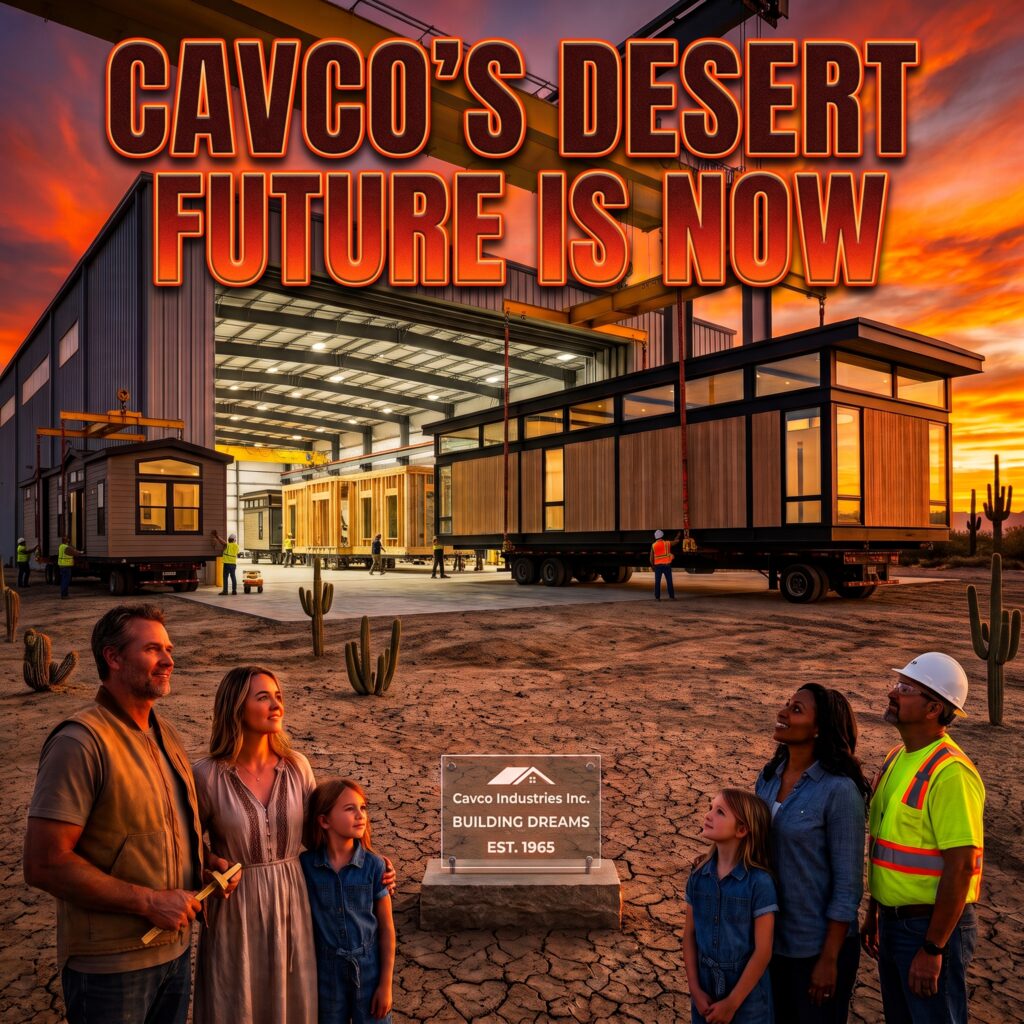
From a sun-scorched Phoenix lumberyard in 1965 to a 616,000-square-foot mega-plant in El Mirage, Cavco’s sixty-year crusade turns offsite fabrication into an architectural rebellion—and a daring, bare-knuckle wager against the housing crisis.
CHAPTER I: THE SAWDUST PROPHET OF 1965
Long before the automated gantry cranes, laser-guided jigs, and Wall Street ticker symbols, there was only the suffocating, 110-degree summer heat of an asphalt lot behind a Phoenix lumberyard.
There was Alfred “Al” Ghelfi, soaked in sweat, breathing sawdust, and bending sheet metal by hand.
In 1965, Ghelfi didn’t have an institutional credit facility or a boardroom. He had a framing hammer, a clutch of hand tools, and a visceral urge to build something durable. He started Cavalier Manufacturing with a simple, blue-collar mandate: handcrafting custom pickup camper shells for working men heading out into the desert. It was raw, sweat-equity carpentry—every rivet set by muscle memory, every miter cut made on an open-air bench.
Then the world caught fire.
When the 1973 OPEC oil embargo slammed the brakes on American highway culture, the recreational vehicle industry cratered overnight. Dealership lots froze. Builders across the country folded their canvas and walked into bankruptcy court.
Ghelfi refused to blink.
Looking across his open-air assembly jigs, he recognized a higher, more desperate human calling. If skyrocketing fuel costs meant families could no longer afford the luxury of roaming, he would pivot his tools to give them something far more sacred: permanent, attainable shelter.
He retooled the entire operation on the fly, traded camper shells for residential framing, and rechristened the company Cavco Industries. It wasn’t an algorithmic hedge. It was a founder’s sheer survival instinct, rooted in the unbreakable conviction that an honest working family shouldn’t have to sacrifice their life savings just to put four solid walls and a roof over their children’s heads.
CHAPTER II: THE SURVIVOR’S DNA & THE 2008 CRUCIBLE
Every veteran in modern construction carries the phantom scars of the 2008 Great Financial Crisis. When the subprime mortgage contagion detonated, it didn’t just rattle the stock market—it pulverized the American homebuilding machine. Decades-old industrial titans that had sheltered multiple generations of Americans, names like Fleetwood Homes and Palm Harbor, were dragged into bankruptcy liquidation. Plant lights went dark across the Sun Belt and the Rust Belt; thousands of multi-generational craftsmen were tossed onto the street.
While the rest of the housing sector curled into a defensive fetal position, Cavco stepped directly into the smoking crater.
Spun out as an independent public company just years earlier, Cavco’s leadership refused to let the craft of offsite shelter die. Between 2009 and 2021, the company orchestrated a string of audacious, contrarian rescues—acquiring and rebuilding Fleetwood, Palm Harbor, Solitaire, and Commodore.
They didn’t merely acquire balance-sheet assets; they walked into silenced factory towns, flipped the breaker panels back on, and called master framers, welders, and millworkers back to their benches.
That survival DNA cemented Cavco’s core corporate ethos: the market will always fluctuate, but the human need for an artful, enduring hearth is eternal.
CHAPTER III: THE 600,000-SQUARE-FOOT WAGER IN EL MIRAGE
Fast forward to 2026. The housing market is once again shivering in a paralyzing freeze—strangled by interest-rate volatility, crippling land costs, and a catastrophic shortage of entry-level homes. Traditional tract builders are retreating, mothballing subdivisions, and waiting for macroeconomic salvation.
Once again, Cavco isn’t flinching.
Instead of pulling back, President and CEO Bill Boor and his executive team dropped a heavyweight bet right onto thirty-nine acres of hard-packed Sonoran caliche in El Mirage, Arizona. Formally announced in their GlobeNewswire Press Release and detailed across the Cavco Corporate Newsroom, Cavco broke ground on a massive, 616,000-square-foot, climate-controlled manufacturing campus.
As detailed by In Business Magazine’s Industrial Coverage, this is not a modest warehouse retrofit. It is a purpose-built cathedral of spatial precision designed to manufacture both HUD-code homes and state-approved modular dwellings:
-
Fourteen Contiguous Acres of Craft: Two mirrored 500,000-square-foot production lines wrap around a central artisan core housing a dedicated cabinet shop, mill shop, and stone countertop atelier.
-
The 72-Degree Maker’s Sanctuary: By bringing the entire building process indoors, hundreds of tradespeople are spared the brutal 115-degree Arizona sun, working in a climate-controlled environment where adhesives, lumber, and high-performance finishes cure under laboratory conditions.
-
Surgical Tolerances: Computer-numeric-controlled (CNC) routers, overhead gantry cranes, and closed-loop dust-collection networks eliminate the structural warping, uneven reveals, and crowning studs endemic to wind-whipped outdoor job sites.
-
Strategic Acumen: As outlined in Cavco’s Investor Relations Disclosures, the campus debuts with one fully optimized line, with infrastructure in place to activate a second line for modest additional capital as regional demand accelerates.
CHAPTER IV: THE AESTHETIC RECKONING
For half a century, the architectural elite sneered at factory-built homes, dismissing them with the tired, lazy trope of “trailers” and banishing them behind restrictive zoning lines.
Today, that cultural stigma is dead.
Modern prefabrication has seized the design high ground. Rather than disguising its industrial roots behind cheap imitation trims, Cavco’s contemporary modular portfolio—celebrated at the Manufactured Housing Institute’s National Design Awards—rivals custom architectural pavilions featured in high-end design monographs:
-
Volumetric Prowess: Single-slope rooflines, soaring trapezoidal clerestory windows, and deep sightlines that flood open-plan interiors with dramatic natural light.
-
Material Honesty: Gone are plastic battens and synthetic veneers. Today’s builds feature seamless drywall, shadow-line reglet reveals, rift-sawn oak cabinetry, and monolithic walk-in wet rooms.
-
Urban Versatility: Multi-module configurations—like the modular duplexes showcased at the HUD Innovative Housing Showcase—allow developers to insert modern, high-density residential architecture directly into tight urban infill lots and desert master plans alike.
CHAPTER V: THE UNWRITTEN DOWNSTREAM PLAYBOOK
Yet, as industry veteran Gary Fleisher often reminds us, a dazzling, automated factory floor is only half the equation. You can engineer aerospace perfection under a 14-acre roof, but the ultimate test of factory-built housing doesn’t happen on the assembly line—it happens in the wild, chaotic world downstream.
Building a factory this massive means staring down three brutal roadblocks that have crushed lesser builders:
-
The Vanishing Set Crews & GCs: A plant can assemble a gorgeous modular home in days, but who is setting the crane rigs and stitching together the marriage lines under a blistering 115-degree sun? The severe shortage of skilled set crews and willing general contractors remains a critical bottleneck.
-
The Bureaucratic Sloth: Factory jigs move at laser speed; municipal zoning boards move like molasses. When local building departments take nine months to approve an infill foundation or grant an occupancy permit, the pipeline backs up directly to the factory doors.
-
The Order Pipeline Beast: Feeding two mirrored production lines and keeping nearly 500 skilled workers steadily paid demands an unrelenting flow of institutional, developer, and retail orders that cannot afford a single seasonal hiccup.
Make no mistake: Cavco didn’t drop hundreds of millions of dollars into the Arizona dirt without seeing the whole chessboard. They know these roadblocks exist. They have undoubtedly mapped out the answers—securing developer pacts, cultivating specialized setting networks, and lobbying zoning corridors—even if they’ve chosen to keep those proprietary plays close to the vest for now.
CHAPTER VI: THE BLOOD, SWEAT & KEYS
Step away from the industrial output metrics, the supply-chain bottlenecks, and the Wall Street quarterly earnings calls.
At its soul, a home is never a line item on a manufacturing manifest. It is the sacred vessel of family life. It is the hardwood floor where toddlers learn to walk, the kitchen counter where homework is spread out under warm pendant light, and the quiet refuge where parents exhale after an exhausting shift.
According to data from the Harvard Joint Center for Housing Studies, factory-built housing remains the single most viable engine for delivering attainable family homeownership at scale without sacrificing structural integrity.
When a working family stands on a patch of desert ground, reaches out, and turns a brass deadbolt for the first time, sixty years of history culminate in that single mechanical click:
-
Spatial Sovereignty: The sudden, overwhelming realization that the endless cycle of double-digit rent hikes and landlord notices is over forever.
-
Generational Pride: A home built with millimeter precision by craftspeople who were treated with dignity, yielding a sanctuary designed to shelter memories for decades to come.
THE FINAL VERDICT: THE DEMOCRATIZATION OF THE HEARTH
From Al Ghelfi sweating out custom camper cuts in 1965 to the state-of-the-art gantry cranes now rising in El Mirage, Cavco’s sixty-year odyssey has never been about mere industrial throughput.
It has been an enduring rebellion against scarcity.
As the National Association of Home Builders Housing Data continues to track the nation’s critical housing deficit, El Mirage stands as a monument to what happens when visionary leadership meets deep-seated grit. Cavco didn’t just build a factory; they built an architectural powerhouse to prove that beauty, security, and the dignity of a front porch are the birthright of every American family.
The factory doors are opening. The lines are moving. And the soul of American shelter is finally coming home.